
Home
BIOLOGICAL INTELLIGENCE
REVOLUTIONIZES
THE FUTURE OF AI
Our product, AGI Designer, will be a powerful new platform for creating next-generation artificial intelligence (AI) agents — harnessing the power of biological intelligence to deliver outstanding gains in cost-efficiency, ease of use, and autonomy. It will feature the first truly self-organizing AI architecture, built on biologically-plausible modular organization and plasticity.
With AGI Designer’s intuitive graphic user interface and drag-and-drop modular design, anyone will be able to rapidly build agents that are efficient, sentient, self-organizing, and learn with minimal human feedback to produce complex, natural behaviors. AGI Designer can save billions of dollars across multiple industries (AI, robotics, and game development) currently spent on data-curation, building and re-training fragile AI systems.
Traditional AI struggles with challenges that biological systems solve effortlessly, such as generalization, energy efficiency, learning with sparse data, and intrinsic motivation. Biological Intelligence has long been a goal in AI research, and its successful integration is key to achieving Artificial General Intelligence (AGI)—where computational agents can match or exceed human performance across a wide range of tasks.
We have successfully reproduced Biological Intelligence in computational agents, including a novel memory system that lets agents learn their environments and create imaginative shortcuts to rewards. This is the origin of ideation.
Our mission is building AGI systems that understand, learn, and apply knowledge like humans.
Our Entience team has decades of experience in studying and modeling biological intelligence. We're available for consultation, and our patented technology is available for commercial licensing. How can we make your AI more naturalistic, more intelligent, and more efficient?
What is Biological Intelligence?
We have shown that Biological Intelligence is a property of nearly all animals that lets them make cost-benefit decisions about resource acquisition, defense, and reproduction. Most animals, even simple ones, make cost-benefit decisions the same way, differing only in the number and kinds of details that they handle in making those decisions. Link to Publication →
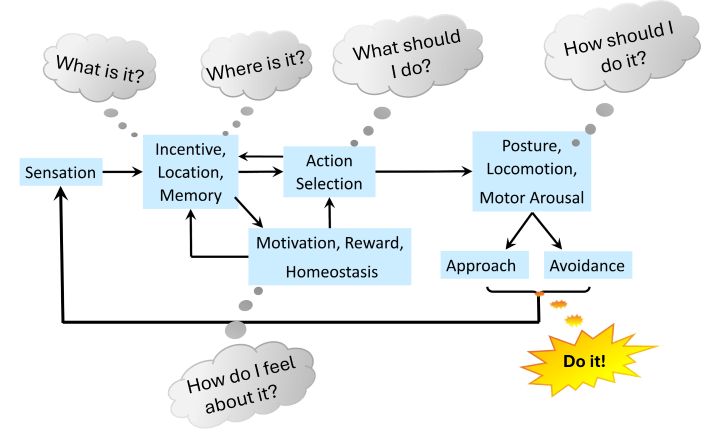
There are five critical computations for decision, in judging sensation and deciding what to do about it. The first four are: What is it? Where is it? How do I feel about it? What should I do? These computations generate sentient consciousness. The fifth is How should I do it? in terms of posture and locomotion. The final decision is sent to the circuits that control the muscles, and the results update the computational train. Nearly all animals do this, differing only in number and kinds of details that they handle.
Consciousness is the product of the brain’s integration of the first four questions for decision which are actively processed during waking. We reproduce it in simple form with easily understandable modifications that are added to approach the experience of higher animals.